How to Use the Omeka S XML Viewer Module

Note: Using this module requires some advanced procedures. If you are considering basic use of Omeka S, please be aware of this. Overview This article explains how to use the XML Viewer module, which enables the display of XML files in Omeka S. It can be used for purposes such as displaying XML files created with TEI. gitlab.com Installation As of March 4, 2022, this module is only published on GitLab and is not available on GitHub. ...
March 4, 2022 · 3 min · Nakamura

[Pinned Post] Welcome to the Digital Archive Systems Technical Blog

This is a blog about digital archive system technologies. In particular, we write articles about Omeka, IIIF, TEI, and related topics. Information about using Omeka is summarized in the following article: Summary of Articles on Omeka S Information about using Omeka.net (Classic) is summarized in the following article: Summary of Articles on Omeka.net (Classic) Articles in the “IIIF” category can be found here: IIIF Category Article List Articles in the “TEI” category can be found here: ...

March 4, 2022 · 1 min · Nakamura

How to Use the Omeka S Mirador Module

Overview This article introduces a module that adds the Mirador viewer to Omeka S. The GitHub repository is available here: github.com Both Mirador 2 and 3 are supported. Various plugins can also be added from the settings screen. In this article, we introduce how to add the “Image tools” plugin, which enables image rotation and horizontal flipping. To use this module, you need to either give Omeka S IIIF server functionality or reference an external manifest file. We plan to cover how to set up the former in a separate article. ...

March 1, 2022 · 1 min · Nakamura

Summary of Articles About Omeka S

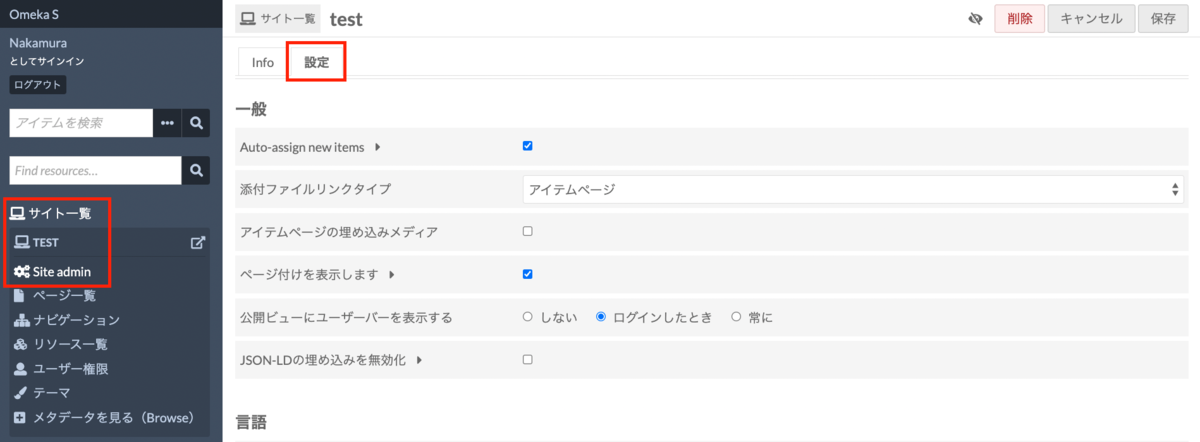
This is a summary of articles about Omeka S. (Updated periodically) Currently migrating to Zenn. For the latest articles, please check the following: zenn.dev For Users How to Install Omeka S and Add Modules Sites Auto-Adding New Items to Each Site Upon Registration Resources How to Add Existing Standard Vocabularies How to Set Language Attributes for Metadata Administration Modules How to Install Modules Identifiers How to Use Clean Url [Video] How to Use Clean Url Clean Url Module Bug and Temporary Fix Maps How to Use the Mapping Module IIIF-Related How to Set Up IIIF Server Using an External Image Server with the IIIF Server Module ...

March 1, 2022 · 2 min · Nakamura

How to Fix Errors with gdown

When using gdown, a dedicated Google Drive downloader, the following error started occurring frequently: Access denied with the following error: Cannot retrieve the public link of the file. You may need to change the permission to ‘Anyone with the link’, or have had many accesses. You may still be able to access the file from the browser: As a workaround, reinstalling gdown as follows resolved the error: !pip install -U –no-cache-dir gdown –pre ...

February 22, 2022 · 1 min · Nakamura

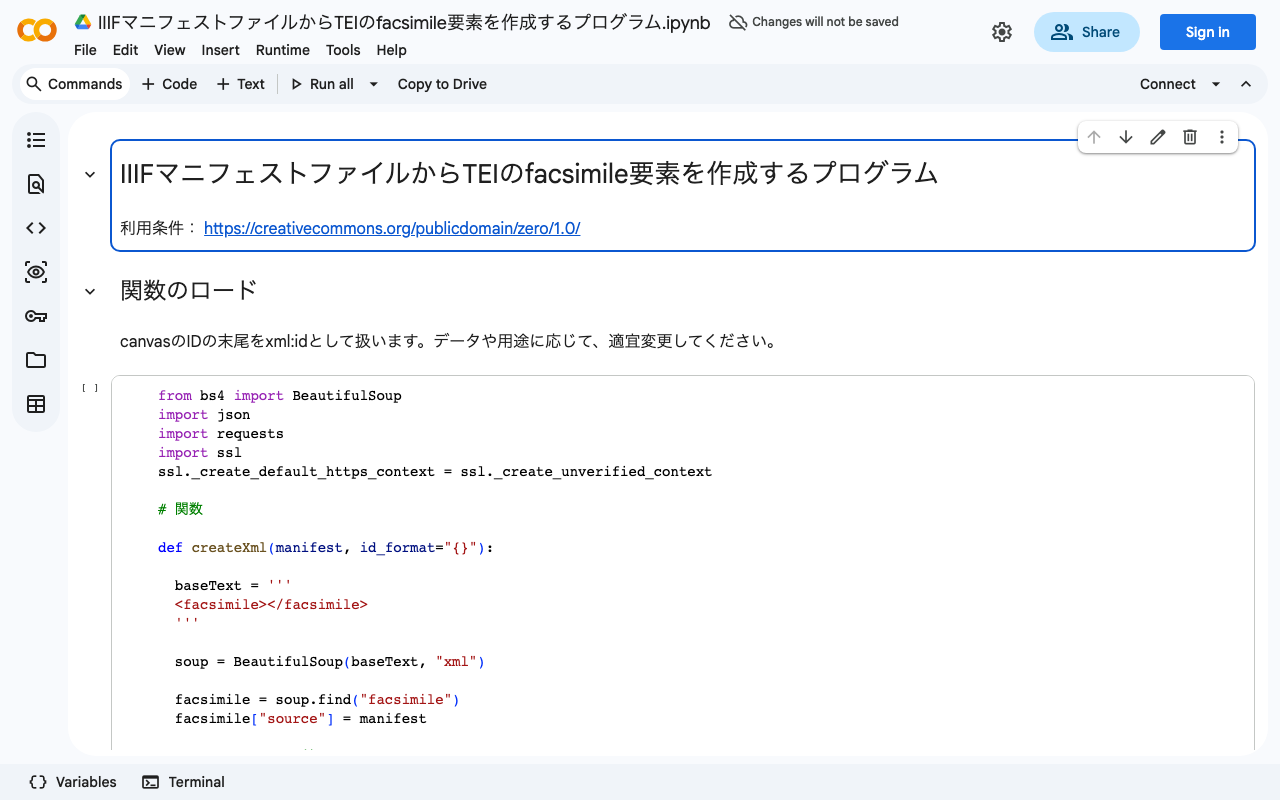
Created a Program to Generate TEI facsimile Elements from IIIF Manifest Files

We created a program to generate TEI facsimile elements from IIIF manifest files. You can try it in the following Google Colaboratory notebook: colab.research.google.com We hope this serves as a useful reference for those considering integration between IIIF and TEI.

February 22, 2022 · 1 min · Nakamura

How to Get an Element with a Specific xml:id Value Using JavaScript querySelector()

This is a memo on how to get an element with a specific xml:id value using JavaScript’s querySelector(). Specifically, for a variable called myDoc, you can retrieve the element as follows. This example gets the element with the value abc in its xml:id attribute. myDoc.querySelector("[*|id=‘abc’]") The key point is to specify it in the format *|(pipe)id. When working with TEI/XML files in JavaScript, there are cases where you need to retrieve elements using xml:id attribute values. Unlike other attributes such as type or corresp, the xml:id attribute has the prefix “xml:” in its attribute name. Therefore, you need to use the approach described above. ...

February 21, 2022 · 1 min · Nakamura

[Omeka S Development] Created a Program to Generate CSV Files for Registering Dummy Data in Omeka S

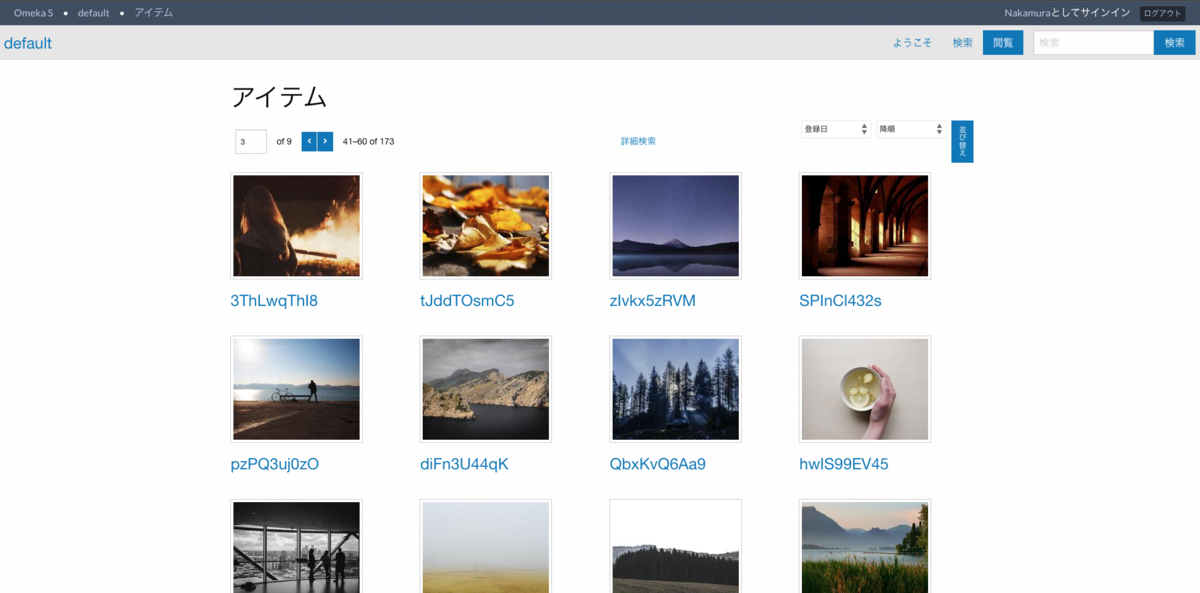
We created a program to generate CSV files for registering dummy data in Omeka S. You can use it from the following Google Colab notebook: https://colab.research.google.com/drive/1Wy865vh9GpUPyiudu1L2A6RPAPXkGPmO?usp=sharing After running it, a CSV file will be downloaded. By using this CSV file with the CSV Import module or the Bulk Import module, you can register dummy data like the following: We hope this is helpful for testing Omeka S functionality or during theme and module development. ...

February 17, 2022 · 1 min · Nakamura

[Omeka S Module Introduction] How to Use the Mapping Module (Especially Batch Registration via the CSV Import Module)

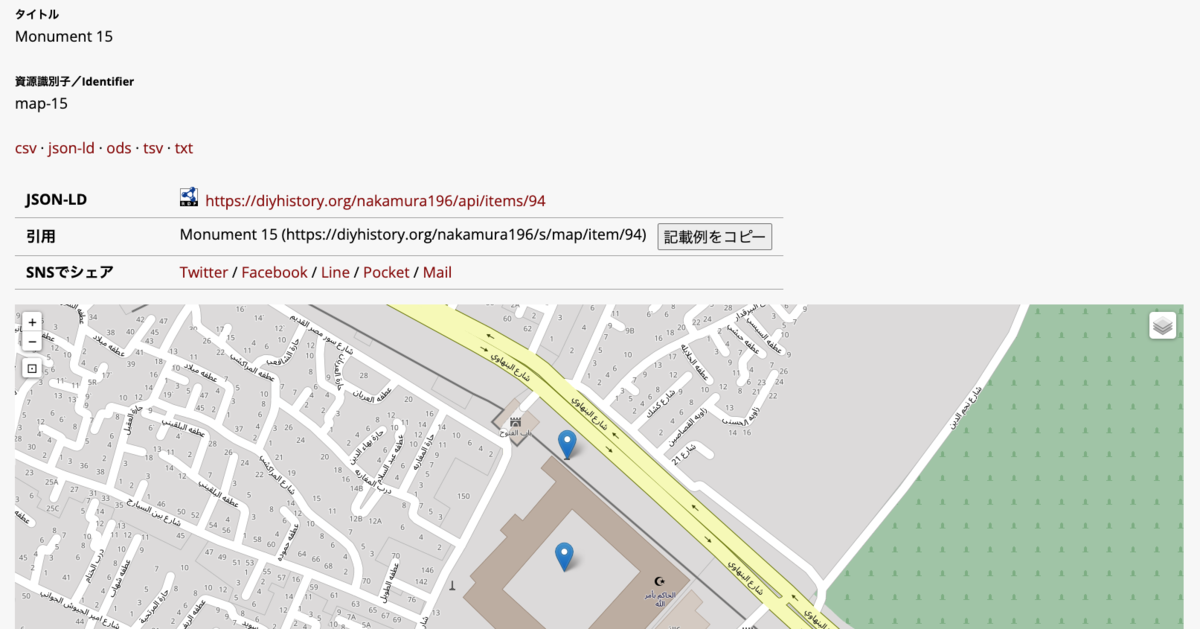
Overview This article explains how to use the Mapping module, which adds maps to Omeka S, with a particular focus on batch registration using the CSV Import module. Omeka S - Mapping Module Installation First, install the Mapping module. Also, for batch data registration, install the CSV Import module. https://omeka.org/s/modules/CSVImport/ If the Bulk Import module is already installed, you need to disable it. Alternatively, consider applying a patch as described at the following link. ...

February 15, 2022 · 2 min · Nakamura

[Omeka S Module Development] Developed a Module to Add Various Export Links to the Item Detail Page

We developed a module that adds various export links to the item detail page. github.com By installing this module, export links like the following are displayed: Specifically, it adds export buttons for JSON-LD, text data, citation, and content sharing. The visibility of each can be configured from the following settings screen: By modifying the Omeka S theme to work with this module’s output, you can achieve buttons and functionality like the following example. (We plan to cover how to modify Omeka S themes in a separate article.) ...

February 14, 2022 · 1 min · Nakamura

[Omeka S Module Development] Developed a Module to Add IIIF Content Search API URIs to IIIF Manifests

Overview I developed an Omeka S module that adds IIIF Content Search API URIs to IIIF manifests. github.com By using the IIIF Content Search API, text search becomes possible in viewers such as Universal Viewer, as shown below. This module uses an IIIF Content Search API that is provided independently of Omeka S. Therefore, to use this module, you need to separately set up an environment that provides this API. While there remains the challenge of the cost of building this environment, I hope this is helpful for those who already have an IIIF Content Search API environment and are considering using it with Omeka S. ...

February 11, 2022 · 2 min · Nakamura

[Omeka S Module Info] Bug in the Clean Url Module and Temporary Fix

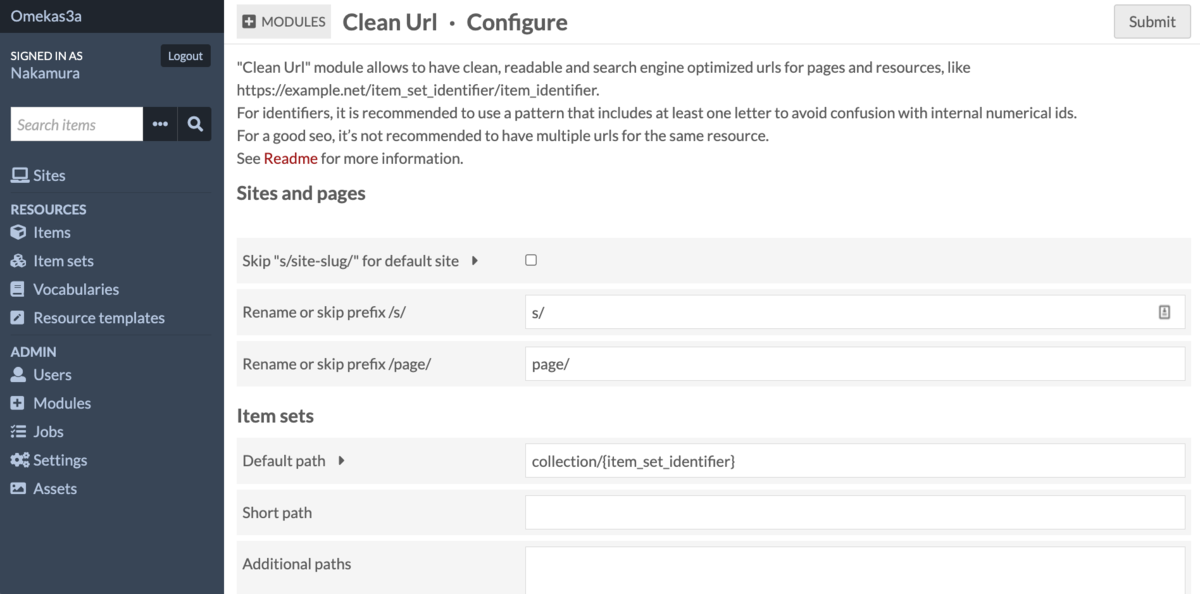
Bug We identified a bug where, after installing the Clean Url module on Omeka S3 and performing the initial configuration, the configured item identifiers were not displayed on the site’s item detail pages and elsewhere. Instead, the automatically assigned Omeka IDs were displayed as-is. Affected Versions OmekaS 3.1.1 CleanUrl 3.17.3.3 Temporary Fix On the settings screen shown below, first check the “Skip ’s/site-slug/’ for default site” checkbox and click “Submit” in the upper right corner. Then, uncheck “Skip ’s/site-slug/’ for default site” again and click “Submit” once more. After this operation, the property ID configured in “Property for identifier” was correctly displayed as the item identifier. ...

February 1, 2022 · 1 min · Nakamura

Released a Chrome Extension for Searching Japan Knowledge

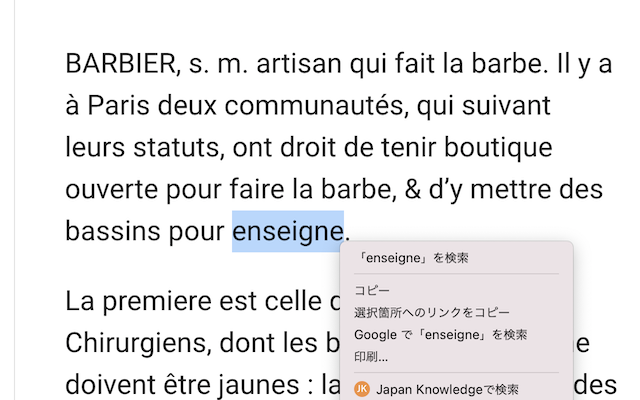
Overview I released a Chrome extension for searching Japan Knowledge. As shown below, it uses the selected text as a query and displays Japan Knowledge search results from the right-click context menu. This article explains how to use this extension. Installation Access the following page and click the “Add to Chrome” button. chrome.google.com Settings Enter the following URL in Chrome’s address bar to configure search settings. There are two input fields: “URL” and “Other queries.” ...

September 30, 2021 · 2 min · Nakamura

How to Enable Mirador 3 Image Tools (Image Rotation, etc.) by Default

Overview This article explains how to enable image tools (such as image rotation) by default in Mirador 3. The default Mirador 3 does not include features that were available by default in Mirador 2, such as image rotation and adjustments for brightness, contrast, and saturation. To add these features, you need to install the image tools plugin: github.com Below, we explain how to install and configure the plugin. Installation In addition to the page above, the following repositories are helpful for installing the image tools plugin. ...

September 16, 2021 · 1 min · Nakamura

[Omeka S Module Introduction] IIIF-Compatible Viewers Available for Omeka S

Overview This article summarizes the IIIF-compatible viewers available as Omeka S modules as of September 15, 2021. Viewer List Universal Viewer github.com Mirador github.com Diva IIIF Viewer github.com Summary You can see installation examples at the following page. We hope this serves as a useful reference for IIIF image delivery using Omeka S. diyhistory.org

September 15, 2021 · 1 min · Nakamura

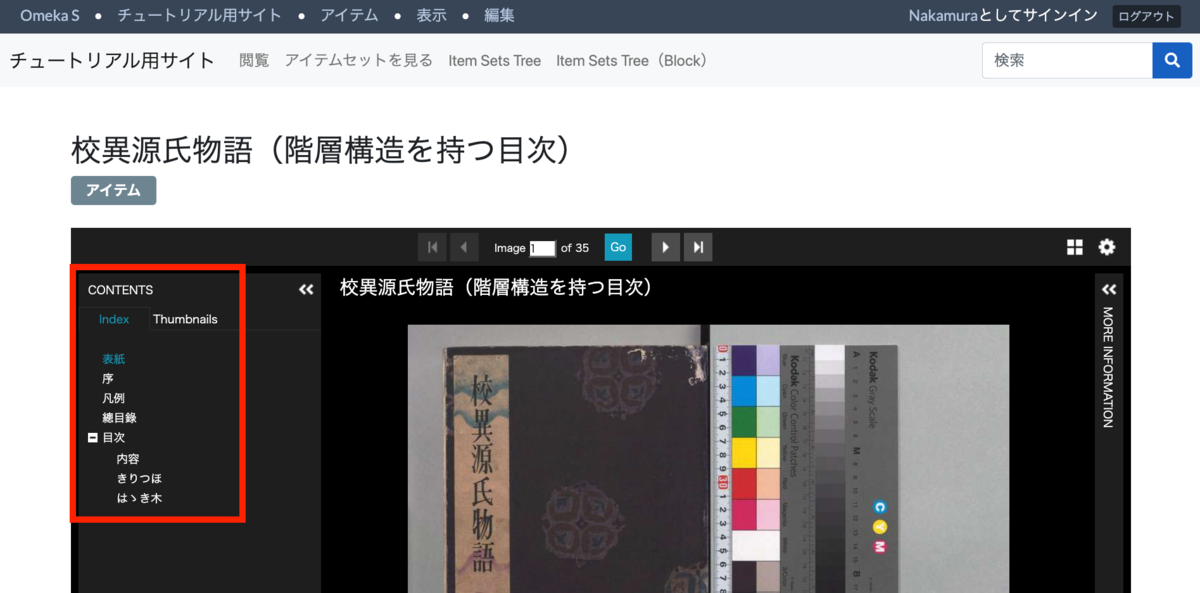
[Feature Development] Added Table of Contents Functionality to the Omeka S IIIF Module (Part 2: Registering Hierarchical Tables of Contents)

Overview In the previous article, I explained how to add a flat table of contents using the Omeka S IIIF Server module. nakamura196.hatenablog.com This time, I explain how to add a hierarchical table of contents. The official manual is available here, and I also created an article translating this manual into Japanese. While the translation is imperfect, I hope it serves as a useful reference. nakamura196.hatenablog.com Details In the previous article, we created a flat table of contents by entering the following information: ...

August 13, 2021 · 2 min · Nakamura

[Feature Development] Added Table of Contents Functionality to the Omeka S IIIF Module (Part 1: Registering Flat Tables of Contents)

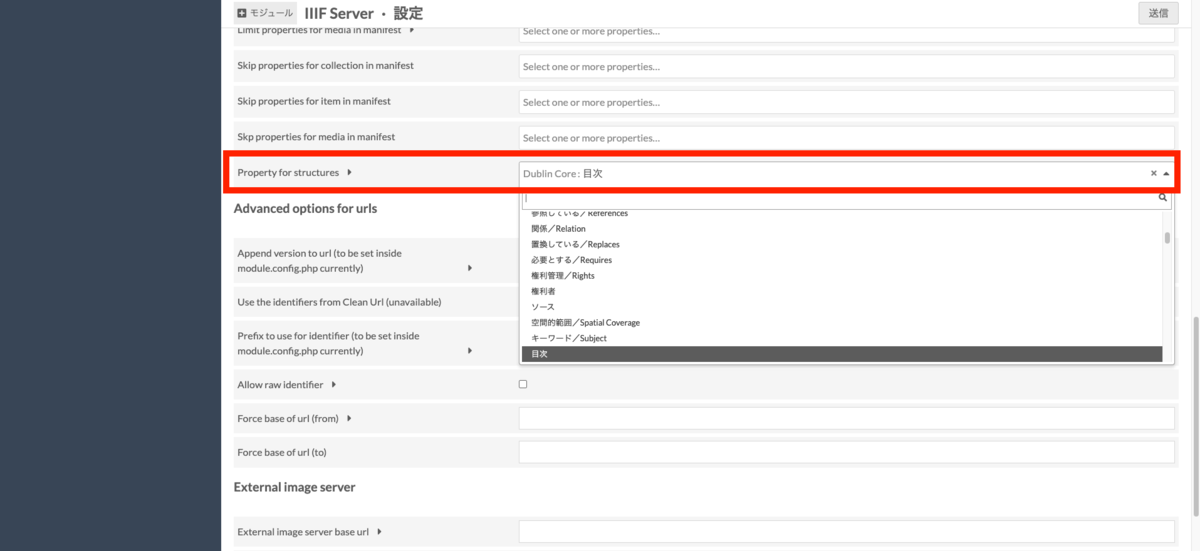
Overview I developed an additional feature for the Omeka S IIIF Server module that adds a table of contents to IIIF manifests. This feature is available from ver 3.6.5.3 onward. github.com This article explains how to add a table of contents using this module. A video tutorial is also available. I hope it serves as a useful reference. youtu.be Details Setup The official documentation is available at: https://github.com/Daniel-KM/Omeka-S-module-IiifServer#config-options-for-manifest First, on the module’s settings screen, select the property to specify for “Property for structures.” By entering table of contents information as the value of the selected property, the table of contents information will be reflected in the IIIF manifest. Here, for example, select “Dublin Core: Table of Contents.” ...

August 13, 2021 · 3 min · Nakamura

[Feature Development] Bug Fix for License Property in the Omeka S IIIF Server Module

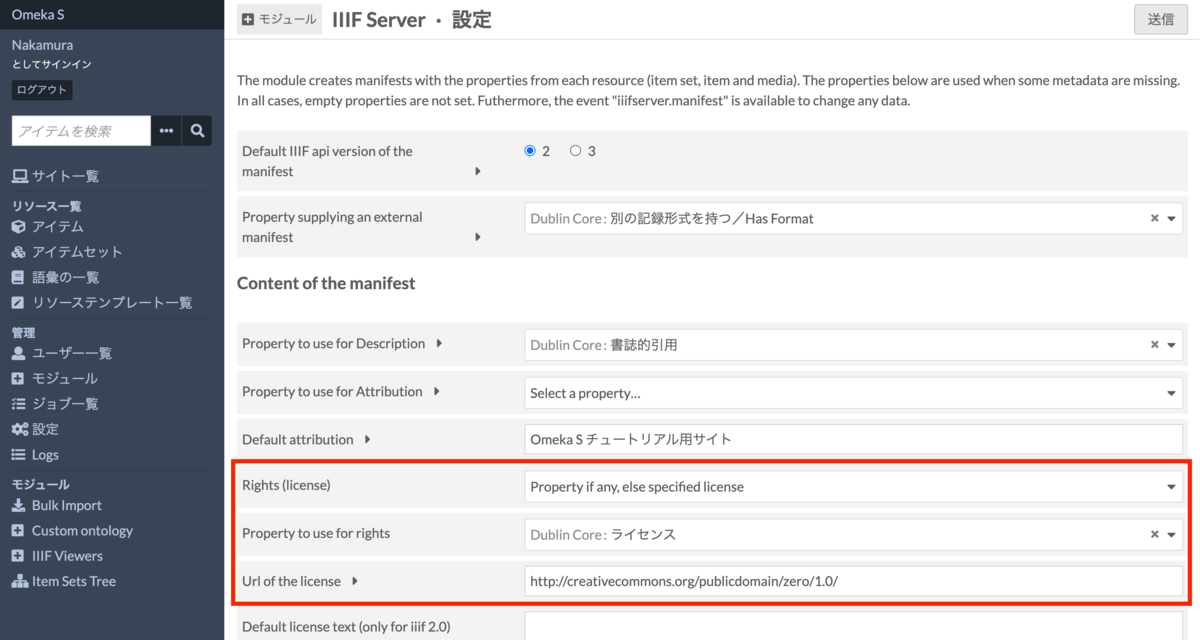
We fixed a bug in the license property of the Omeka S IIIF Server module when using IIIF Presentation API version 2. Specifically, we fixed an issue where the license-related settings in the IIIF Server module were not reflected in the IIIF manifest. The module with this fix is available from version 3.6.5.3 onward. github.com We hope this serves as a useful reference for those affected by this bug. ...

August 13, 2021 · 1 min · Nakamura

[Translation] How to Add Table of Contents Information in the Omeka S IIIF Server Module

This is a Japanese translation of the manual on how to add table of contents information in the Omeka S IIIF Server module. The official manual is available below. github.com I hope this serves as a reference when adding table of contents information to IIIF manifests using this module. Config options for manifest Input format of the property for structures (table of contents) The default structure is a simple sequential list of IIIF media. ...

August 11, 2021 · 8 min · Nakamura

How to Embed Mirador 3 in a Specific Area of a Page

In a previous article, we introduced how to embed Mirador in a specific area of a page using Nuxt.js. nakamura196.hatenablog.com This time, we introduce how to embed Mirador without using frameworks like Vue.js. Specifically, please check the source code of the following page. https://nakamura196.github.io/nuxt-mirador/embedded2 The above is a simple HTML file. When embedding Mirador on a page, you specify the ID of the element where Mirador will be displayed (e.g., mirador). By applying the following CSS, you can embed it within a portion of the page. ...

August 10, 2021 · 1 min · Nakamura