How to Delete a Feature Store in GCP Vertex AI

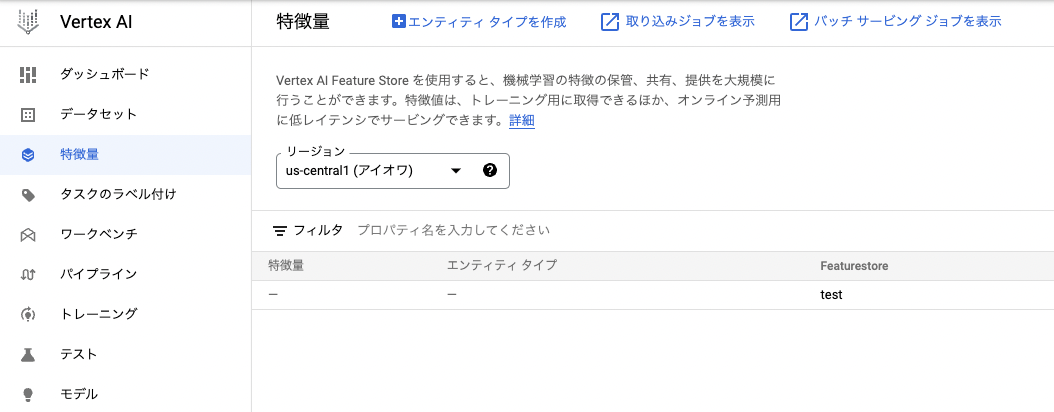
Overview This is a note on how to delete a feature store in Vertex AI on GCP (Google Cloud Platform). I later noticed that official documentation was available at the following link. https://cloud.google.com/vertex-ai/docs/featurestore/managing-featurestores#delete_a_featurestore Method In this example, I will attempt to delete a feature store called test as shown below. It could be deleted by executing the following command. (I was unable to find a way to delete it from the GUI.) ...

April 5, 2022 · Updated: April 5, 2022 · 1 min · Nakamura

How to Use pyvips and Create Pyramid Tiled TIFF Files

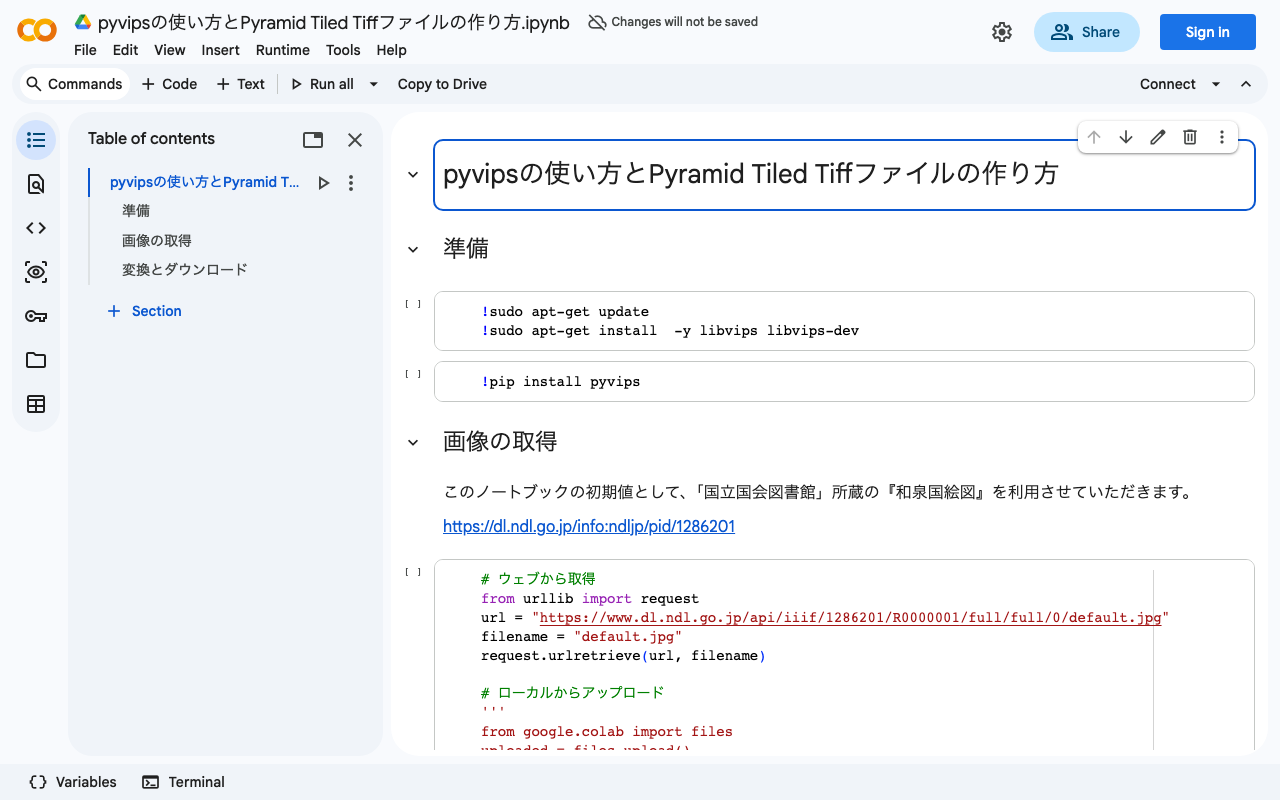
Overview I created a program to generate Pyramid Tiled TIFF files using pyvips. You can try it on the following Google Colab. https://colab.research.google.com/drive/1VO1PgKgS3H21zXpg4g2inN-mtIrON5TQ?usp=sharing When delivering images via IIIF, there are situations where Pyramid Tiled TIFF files need to be created. We hope this is helpful for image conversion using Python and Vips. The parameters are based on the following. https://github.com/samvera-labs/serverless-iiif#using-vips Also, as one example of how to deliver converted Pyramid Tiled TIFF files, the following article may also be helpful. ...

March 30, 2022 · Updated: March 30, 2022 · 1 min · Nakamura

[Memo] How to Use Maplat

This is a memo on how to use Maplat, a historical map viewer library. https://github.com/code4history/Maplat In addition to the above GitHub repository, the following Qiita articles are also helpful. https://qiita.com/tags/maplat?page=1 Downloading MaplatEditor Download the latest version of MaplatEditor from the following page. https://github.com/code4history/MaplatEditor/wiki Creating Data Launch the installed MaplatEditor and click the “New” button. Enter the required metadata. The items shown in the figure below are mandatory fields. ...

March 25, 2022 · Updated: March 25, 2022 · 4 min · Nakamura

I Created a Calendar Search App

Overview I created a web application that displays information in a calendar format. Below is a display example targeting a list of Hatena Blog articles. https://static.ldas.jp/calendar/?u=https://nakamura196.github.io/json/calendar.json https://github.com/ldasjp8/calendar You can check the display example by accessing the following URL and clicking the “Example” button, then the “Add” button. https://static.ldas.jp/calendar/ You specify the URL of a JSON file in the following format as a parameter. https://nakamura196.github.io/json/calendar.json Below, I will explain how to create the JSON file from an Excel file as one example method. ...

March 24, 2022 · Updated: March 24, 2022 · 2 min · Nakamura

Building an Object Detection API Using AWS Lambda (Flask + YOLOv5)

Overview We build an object detection API (Flask + YOLOv5) using AWS Lambda. By building a machine learning inference model using AWS Lambda, we aim to reduce costs. The following article was used as a reference. https://zenn.dev/gokauz/articles/72e543796a6423 Updates to the repository contents and additions of how to use it from API Gateway have been made. Registering Functions on Lambda Clone the following GitHub repository. git clone https://github.com/ldasjp8/yolov5-lambda.git Running Locally Next, create a virtual environment using venv and install the modules. ...

March 24, 2022 · Updated: March 24, 2022 · 4 min · Nakamura

[Omeka S Module] How to Use Clean Url

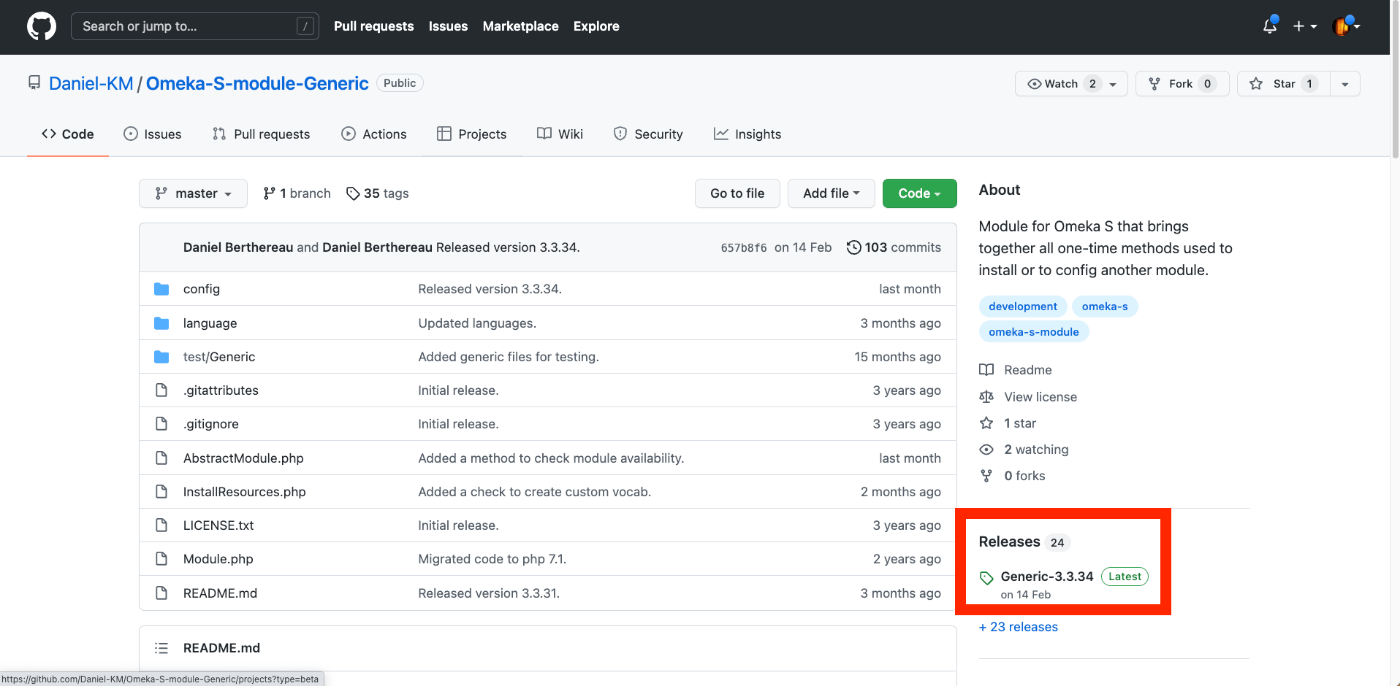
Overview This article explains how to assign identifiers to resources (item sets, items, media) in Omeka S. Specifically, it explains how to use the “Clean Url” module. https://github.com/Daniel-KM/Omeka-S-module-CleanUrl Installation The following assumes that Omeka S is installed in a folder named omeka-s-sandbox. /home/xxxx/www/omeka-s-sandbox/ The README recommends installing the related module “Generic.” https://github.com/Daniel-KM/Omeka-S-module-CleanUrl#installation Execute the following. wget https://github.com/Daniel-KM/Omeka-S-module-Generic/releases/download/3.3.34/Generic-3.3.34.zip unzip Generic-3.3.34.zip The above is an example of downloading Generic v3.3.34. For the latest version, access the following and obtain the URL from the location shown in the screenshots. ...

March 23, 2022 · Updated: March 23, 2022 · 4 min · Nakamura

Installing Omeka Classic

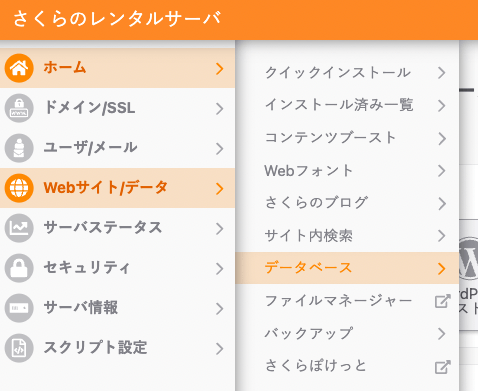
This guide assumes the use of Sakura Rental Server. If you are using a different server, please adapt the instructions accordingly. Creating a Database On Sakura Rental Server, create a new database as follows. Installing Omeka Classic Connect to Sakura Rental Server via SSH. The command looks like the following, where xxxx is your username. ssh xxxx@xxxx.sakura.ne.jp In this case, we will install a new Omeka Classic at the following path. ...

March 22, 2022 · 3 min · Nakamura

[Summary Article] How to Use Omeka.net (Classic)

This explains how to use Omeka.net. Chapters 3 and beyond are common with Omeka Classic usage. Creative Commons - BY – 2014 Use Case: Scholars, Omeka.net, http://info.omeka.net/omeka-net-help/use-case-scholars/ (Translation & Revision: Satoru Nakamura) — - Chapter 1 Overview - Chapter 2 Sign Up and Plan Selection - Chapter 3 Adding Items - Chapter 4 Managing Tags - Chapter 5 Exhibit Builder - Chapter 6 Simple Pages - Chapter 7 Managing Users

March 22, 2022 · 1 min · Nakamura

[Google Colab] Retrieving Article Lists Using the Hatena Blog AtomPub API

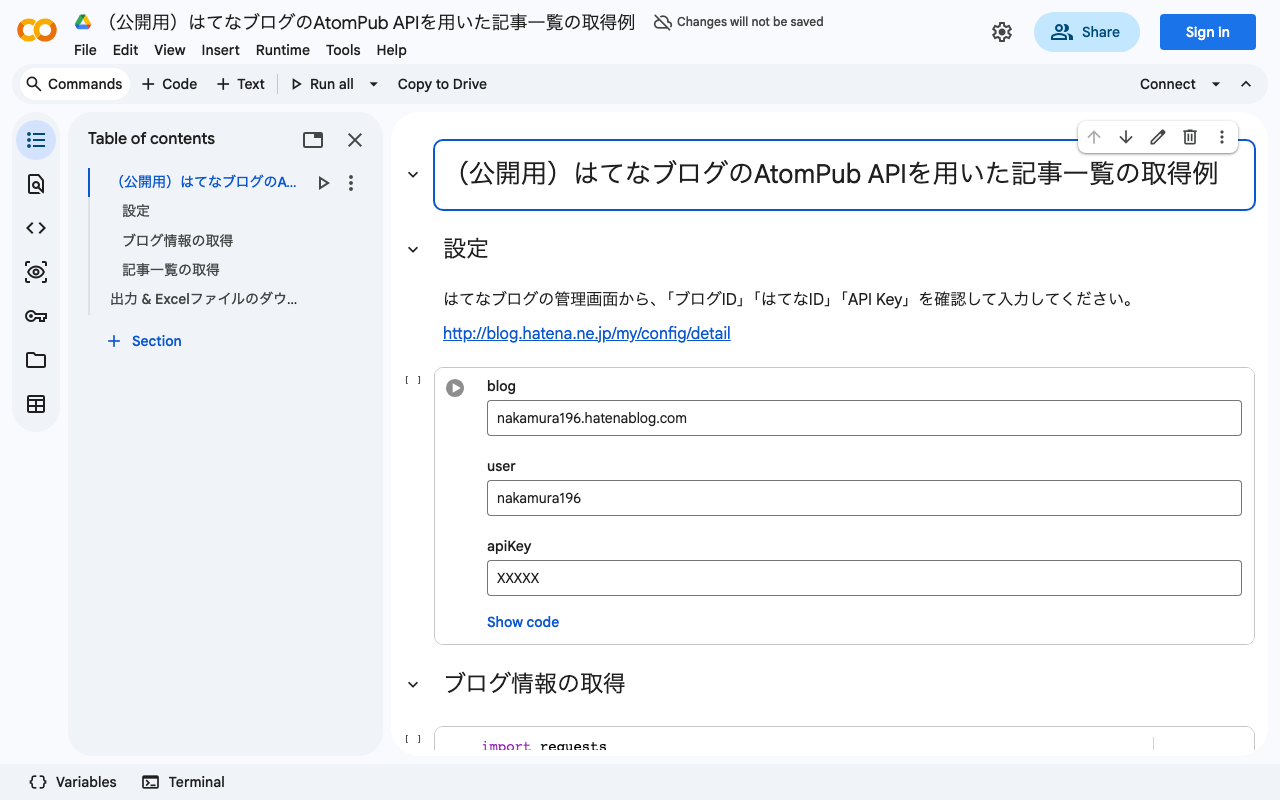
I created a sample program for retrieving article lists using the Hatena Blog AtomPub API. You can try it on the following Google Colab. https://colab.research.google.com/drive/15z0Iime9Bbma7HW09__Fq_fRkcWP6nyS?usp=sharing After running the above program, an Excel file like the following will be downloaded. https://docs.google.com/spreadsheets/d/14myDqZTxocwOT0Mw3ZzKLO81E6r15R-49oUh2dG9Rbo/edit?usp=sharing The “metadata” sheet stores blog information, and the “items” sheet stores the list of articles. Some aspects may be unclear due to the notation in column A of the “metadata” sheet, the heading rows, and the heading rows of the “items” sheet (which are designed for connection with other applications), but I hope this is helpful when using the Hatena Blog AtomPub API. ...

March 22, 2022 · Updated: March 22, 2022 · 1 min · Nakamura

How to Use a Flask-Based YOLOv5 Model Repository with ECR and AWS App Runner

This article introduces an example of building an object detection API using AWS App Runner and YOLOv5. Amazon ECR I registered the following repository, which publishes a YOLOv5 model using Flask, to the Amazon ECR (Elastic Container Registry) public registry. https://github.com/robmarkcole/yolov5-flask https://gallery.ecr.aws/b8m8i5m3/yolov5-flask I made some modifications to the source code from the original repository. The forked repository is here: https://github.com/ldasjp8/yolov5-flask Below, I will explain how to use this image with App Runner as an example. ...

March 21, 2022 · Updated: March 21, 2022 · 1 min · Nakamura

Health Check on Port Issue When Using AWS App Runner + ECR

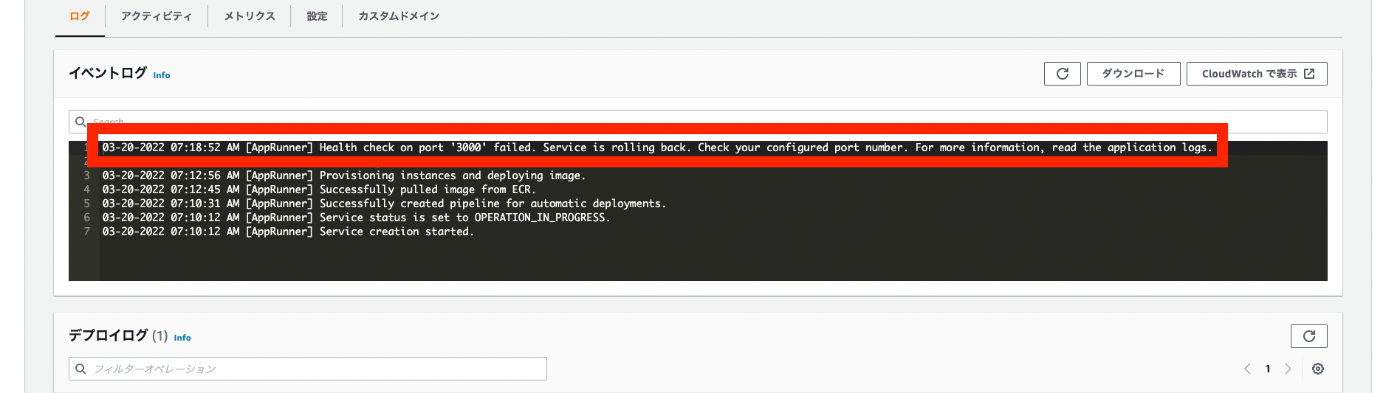
When using ECR as the source in AWS App Runner, the following Health check on port “XXXX” error occurred. 03-20-2022 07:18:52 AM [AppRunner] Health check on port '3000' failed. Service is rolling back. Check your configured port number. For more information, read the application logs. Regarding the above, I checked the “Application logs” as follows. The following was output. exec user process caused: exec format error Regarding the above, I found the following Stack Overflow post. ...

March 20, 2022 · Updated: March 20, 2022 · 1 min · Nakamura

[For Developers] Setting Up a Search Application Development Environment Using AWS x Nuxt.js x Elasticsearch

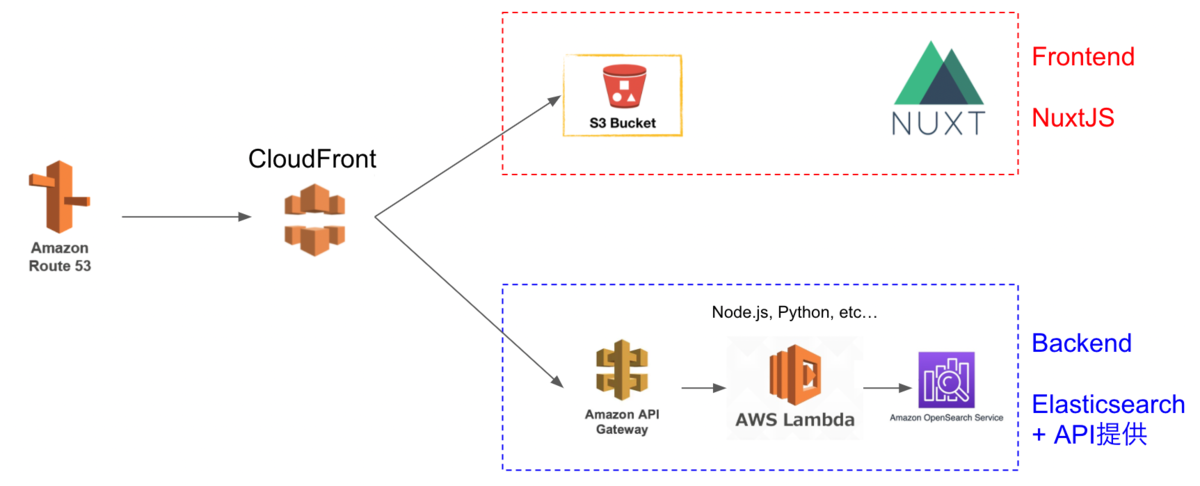
This article explains how to set up a development environment for a search application using AWS x Nuxt.js x Elasticsearch. This is primarily a personal reference note. We aim for the following architecture. While there may be better configurations and approaches, this at least provides a working development environment for a Nuxt.js web application using Elasticsearch as the search engine on AWS. The Cultural Japan project also uses a nearly identical architecture. ...

March 12, 2022 · 6 min · Nakamura

Registering Resource Classes with Bulk Import and Editing Settings

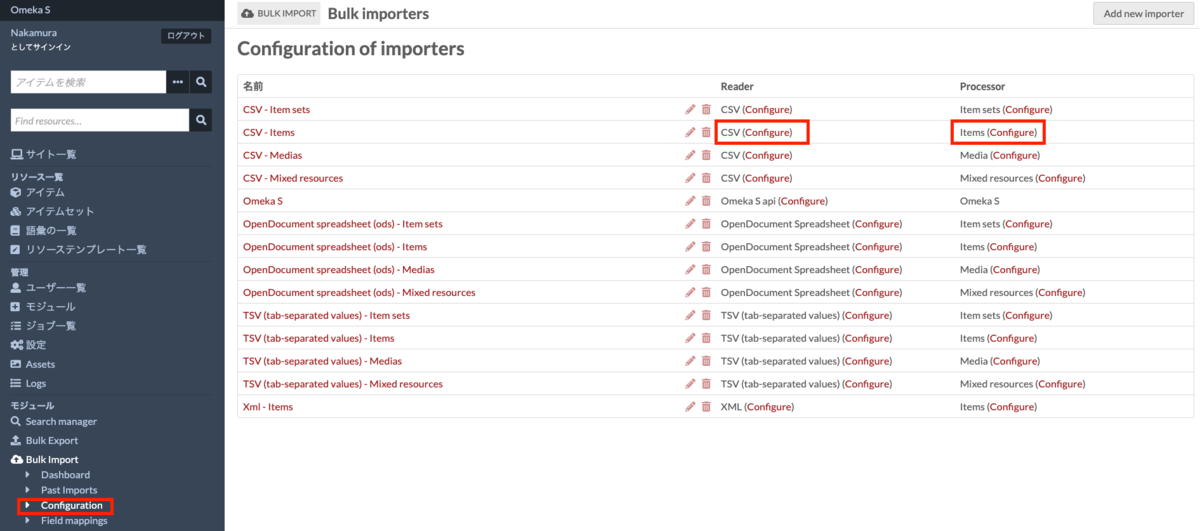
I have written the following articles about batch registration and updating using Bulk Import. nakamura196.hatenablog.com nakamura196.hatenablog.com Since the above articles did not cover how to register resource classes, I address this here. I also provide supplementary information on how to edit Bulk Import module settings. Registering Resource Classes I have prepared a sample CSV file for registering resource classes at the following link. https://github.com/omeka-j/Omeka-S-module-BulkImport-Sample-Data/blob/main/resource_class/sample.csv The key point is to set the column name to “o:resource_class.” The cell values should be the Term values that can be confirmed in Omeka S. For example, enter values such as dctype:Collection. ...

March 11, 2022 · 2 min · Nakamura

Created a Program for Batch Updating File Owners in Google Drive

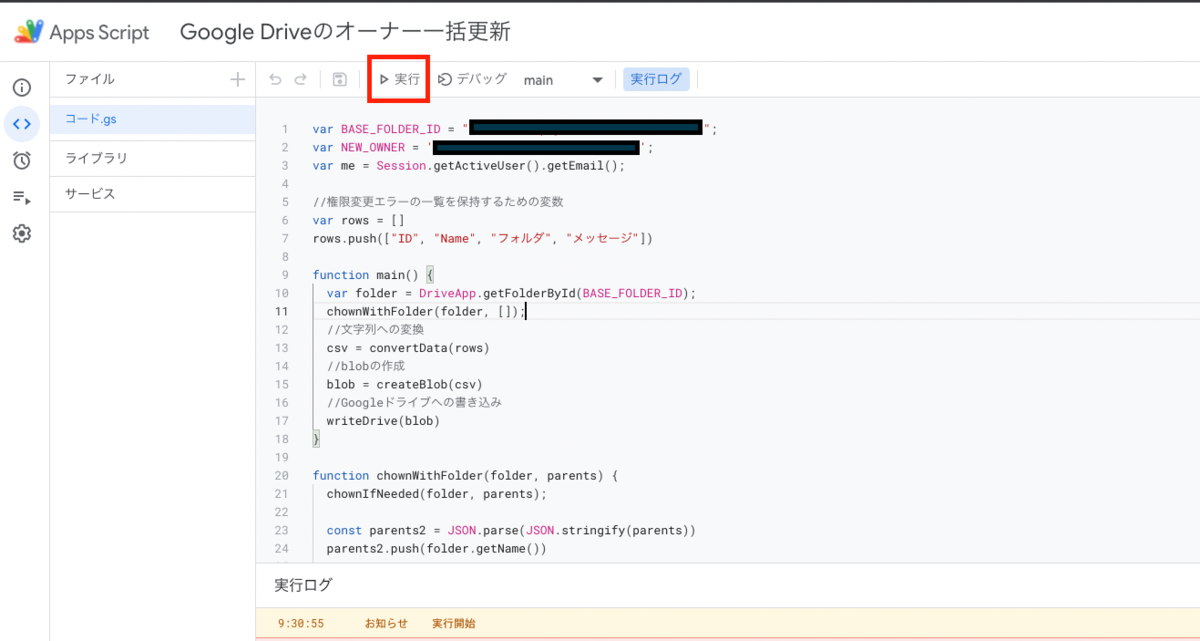
I created a program for batch updating file owners in Google Drive. Below, I explain the process separately for the person transferring ownership and the person receiving ownership. Please note that this program cannot transfer ownership of PDF or image files. The workaround for this is described later. Person Transferring Ownership Access the Google Apps Script at the following link and follow the instructions. https://script.google.com/d/1k6ZiwHNeJSvc4W7uRmc_DfSSmwGOWCbUriLBy0MpuoEAgWvcVNdyRMDa/edit?usp=sharing After navigating to the Apps Script page, press the “Run” button. ...

March 11, 2022 · 2 min · Nakamura

[Memo] Created a Program for Batch Deleting Folders on Google Drive

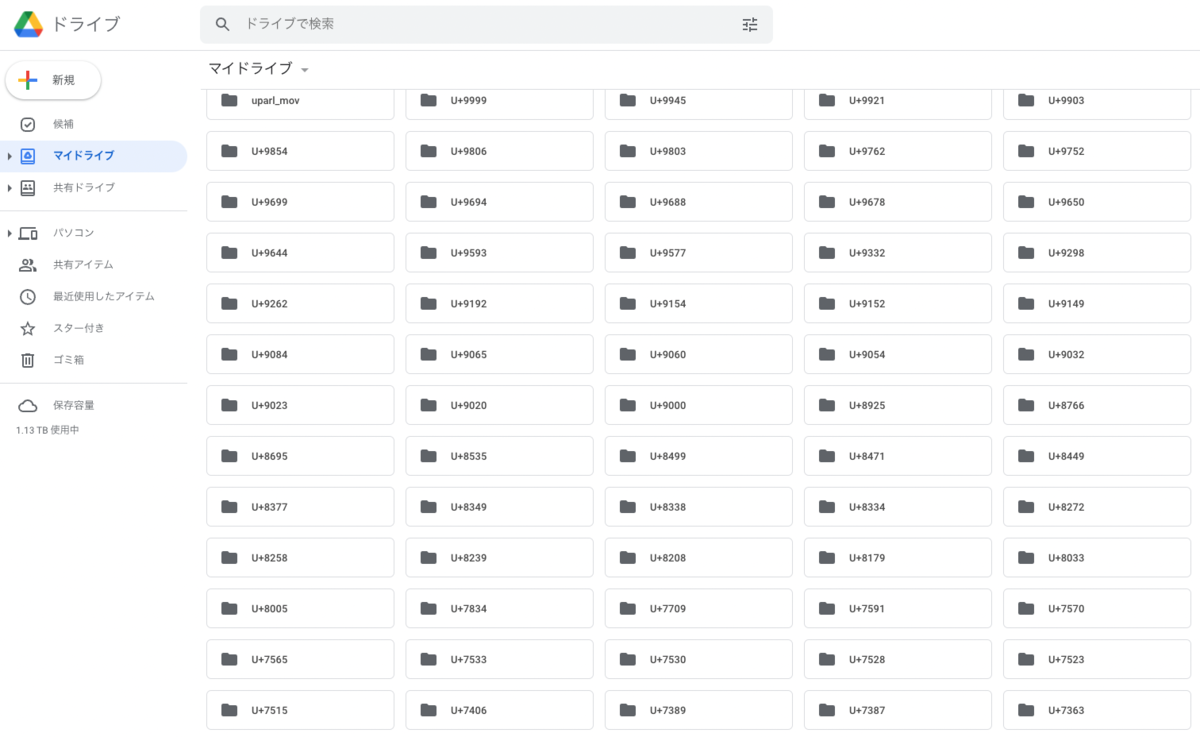
Background While working with a kuzushiji (classical Japanese character) dataset, a data processing error resulted in creating a large number of folders with Unicode names directly under My Drive. To address this issue, this article explains a program for batch deleting multiple folders on Google Drive. Note that this article primarily serves as a personal memo. Target Audience Those with knowledge of Google Cloud Platform Solution To solve this problem, we created a sample program for batch deleting folders on Google Drive. You can try it in the following Google Colaboratory notebook: ...

March 9, 2022 · 1 min · Nakamura

How to Install Omeka S Modules

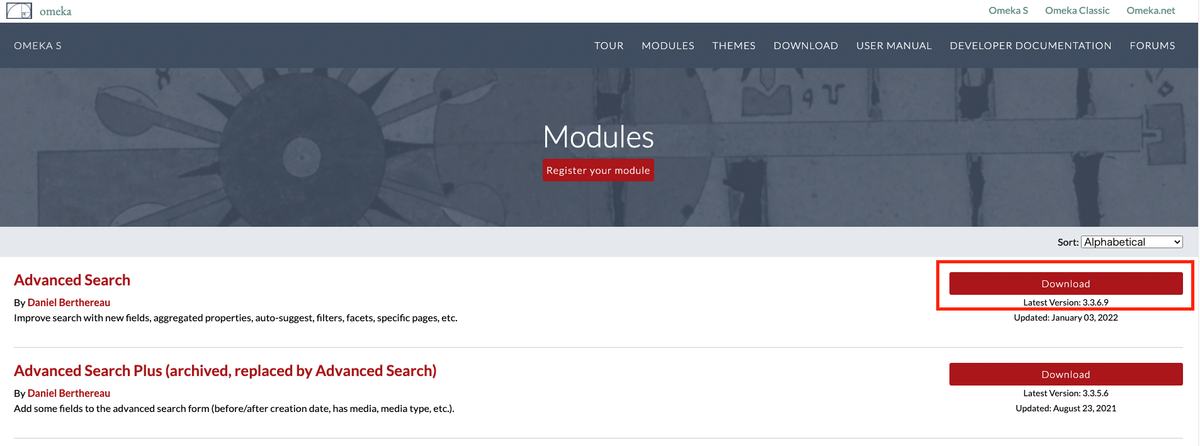
This article summarizes how to install Omeka S modules. A. From the Official Site First, you can download zip files from the official site below. https://omeka.org/s/modules/ Clicking the download button above will download a zip file. Extract the folder and place it in the modules folder within the Omeka S installation directory. This is the most basic method. An explanatory video is also available, so if this is your first time, please refer to the following video: ...

March 9, 2022 · 2 min · Nakamura

Batch Updating Metadata Using CSV Files with Bulk Import

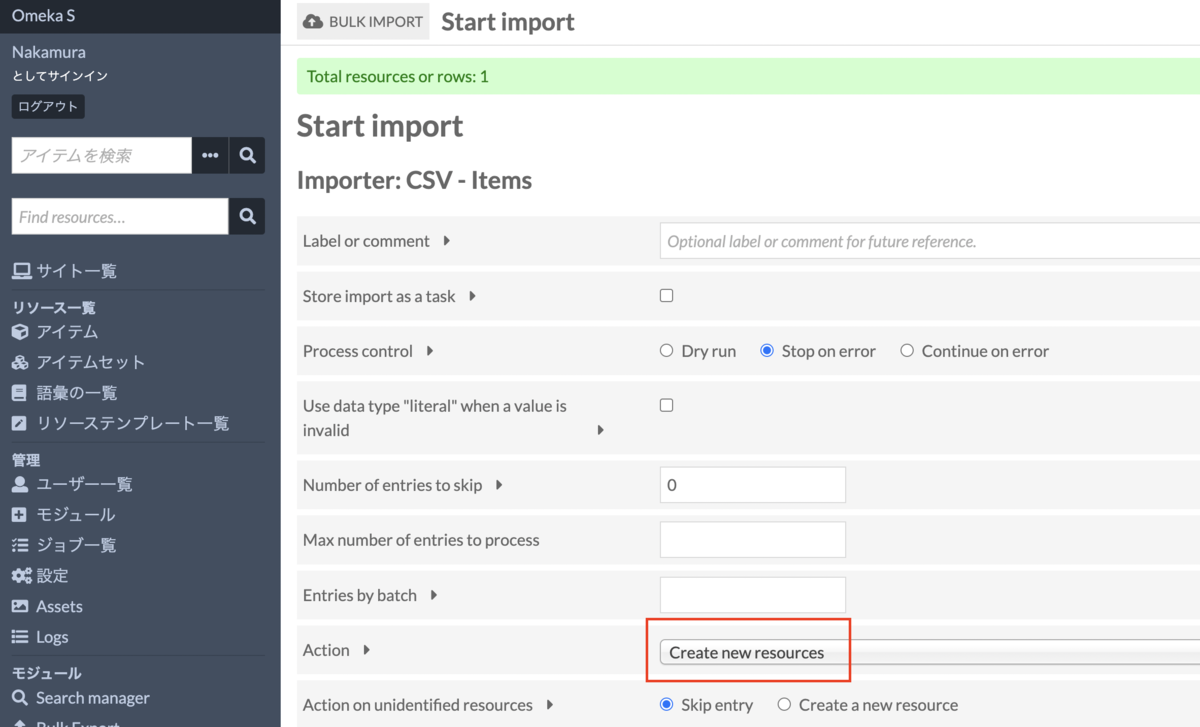
Introduction In the following article, I explained how to batch register metadata and images using CSV files with Bulk Import. nakamura196.hatenablog.com This article explains how to batch update already registered metadata. Procedure Bulk Import offers the following five options: Create new resources Append data to resources Revise data of resources Update data of resources Replace all data of resources Delete resources Below, we examine the behavior of each option. 1. Create new resources First, as with the batch registration method shared earlier, we use the “Create new resources” option. ...

March 8, 2022 · 4 min · Nakamura

Notes on Japanese Full-Text Search in Omeka S and the Mroonga Search Module

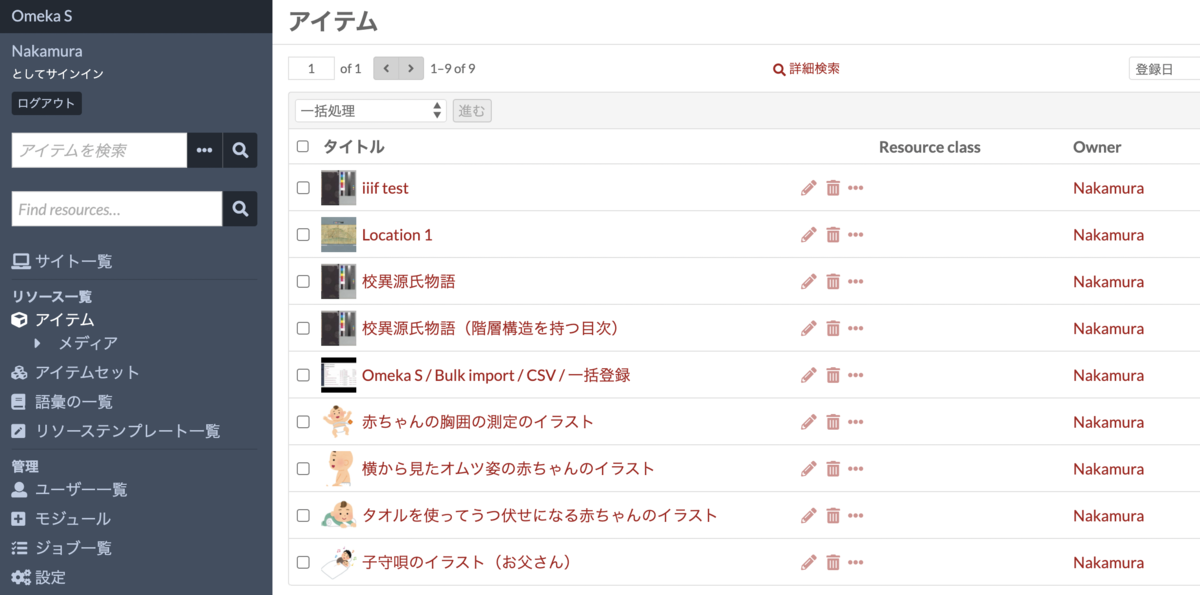
Issue Omeka S provides full-text search functionality, but unfortunately, Japanese search does not work properly with default settings. Specifically, partial match search does not function correctly. For example, assume that multiple items with titles containing the string “Koui” (校異) are registered, as shown below. When entering “校異” (Koui) in the full-text search form at the top left, the search returns 0 results. On the other hand, entering “校異源氏物語” (Koui Genji Monogatari) returns the correct search results. ...

March 7, 2022 · 3 min · Nakamura

Created a Sample Program for Analyzing TEI/XML Files with Python

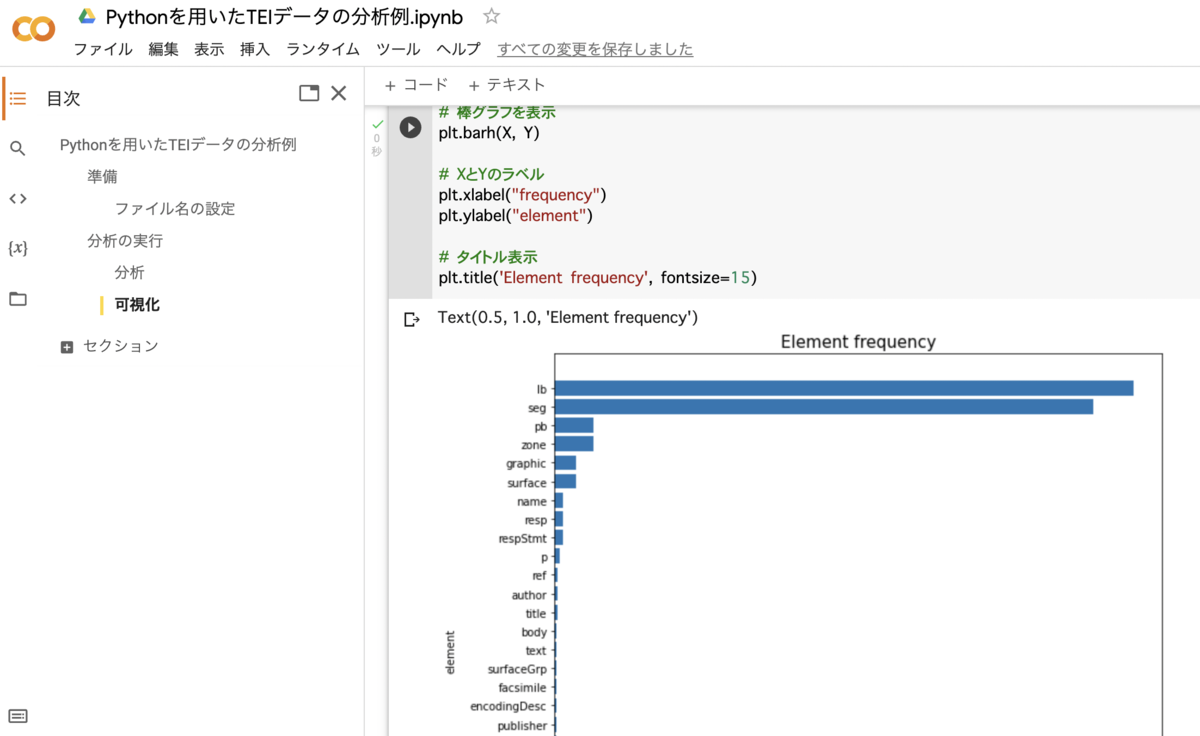
We created a sample program for analyzing TEI/XML files with Python. You can use it from the following Google Colab notebook: https://colab.research.google.com/drive/1fji80KZW8typjJMi01fyUWjrdYrNldsK We hope this serves as a useful reference for those considering the utilization of TEI data.

March 6, 2022 · 1 min · Nakamura

Created a Program for Batch Downloading Images from IIIF Manifest Files

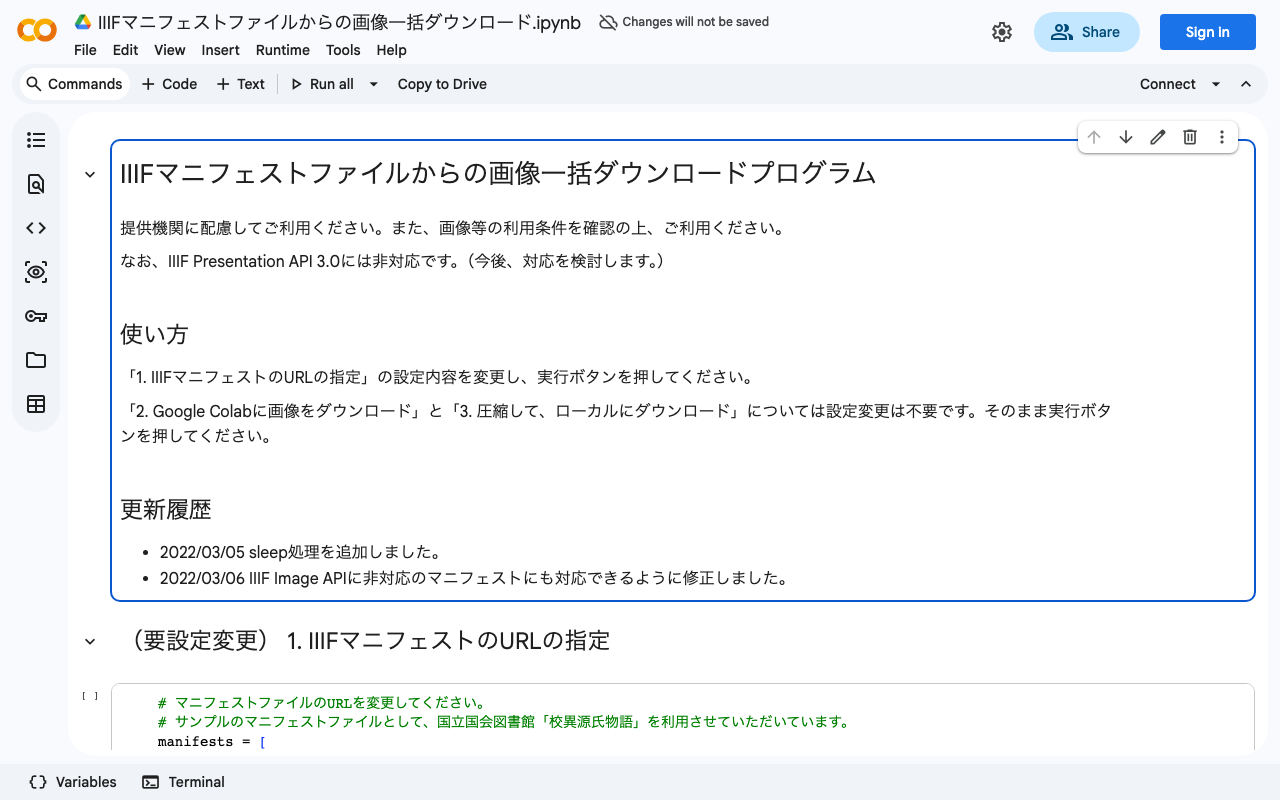
We created a program for batch downloading images from IIIF manifest files. You can use it from the following Google Colab notebook: https://colab.research.google.com/drive/1XL6cnY6fdtYTB5EdNA_B_EfqKHXZMDQJ?usp=sharing Please use it with consideration for the providing institutions. Also, please check the terms of use for the IIIF manifest before using it.

March 4, 2022 · 1 min · Nakamura